This was their favorite so far. We went Friday night. I bought a coupon book online before getting there so we saved a few bucks just getting in. It included one ticket, a drink and this combo plate. The kids got in free. That plate was enough for all of us.
We had Lamb (something I never ate as a kid, but they all tried it),
Dolmathes - Beef, rice and spices mixed and rolled in tender grape leaves and baked in lemon sauce.
Pastitsio - Layers of ground beef and macaroni topped with cream sauce and baked.
Greek Salad
Rice Pilaf
and they gave us 2 rolls to split between us.
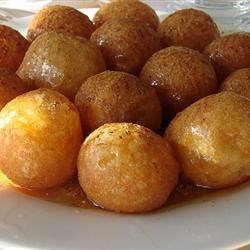
They loved the Loukoumathes (or Loukoumades) which are basically like light doughnut holes drenched in honey and sprinkled with cinnamon or powdered sugar. They liked it so much I looked up the recipe and it is super easy so maybe I'll make it for breakfast or special occasions.
The dancers were scheduled for earlier, but ended up postponing the start of their dance until the sun went down. So we had some time to sit and enjoy all of these pastries. There was a lot of honey, cinnamon and walnuts. There were two types of cakes; a spice cake and a chocolate cake. A lot of the dough was crispy, then soaked in honey. We were a sticky mess while we ate.
These are Diples; which are giant rolls of crispy pastries that had honey, cinnamon and walnuts.
Finally the dancers came on. There were 3 age groups. This was the middle age group.
These were high school/college age kids. Those kids had a lot more dance moves and we really enjoyed watching them. The kids tried to duplicate their moves when we got home.
After the dancers, they lit the giant torch. The weather was perfect, they loved all of the food and overall they really had a good time.
A great resource for learning about World Cultures is Food Festivals. I was surprised just how many there are in my area. Not only is there food, but there is usually entertainment related to the culture and that includes dancing and singing. The key to saving money is don't buy souvenirs, don't go on any rides, catch the show and chose a few different entrees to share between you.
Once you've sampled the cuisine, try making it at home. I'm using this portion as part of our Health/Nutrition course and having my oldest research healthier options to cook at home.
Food Reference.com is great for searching for what's in your area. They have it listed by State, Month and even country in case your are traveling.
Here's a list of names to search for. I would link, but it appears each festival location has it's own website.
Italian
San Gennaro Feast
Greek
Greek Food Festival
Usually at your local Greek Orthodox Church
German
Oktoberfest
In October of course ;)
China
Chinese New Year
Between late January to early February
China
Moon Harvest Festival
Usually in September to October, but can be as early as August
Polynesian
Polynesian or Aloha Festivals
International
Heritage Festival or Culture Festival - town usually puts on.
Ours has Japanese, Korean, Irish, German, Mexican, Polynesian, and Bulgarian dancers and entertainers.
Japanese
Aki Matsuri
For even more culture, don't forget to look up holidays such as Dios De Los Muertos (Mexican Day of the Dead) - can be a bit scary for the younger kids.
There's a lot more out there, I'll be adding as I find them.
Every night when I'm making dinner, my 6 year old daughter begs to help. I usually have a few things she can do, but this week I planned a menu that is kid friendly. This is her making Lasagna.
She browned the meat.
Mixed the Ricotta and layered everything. I just grated the cheese and put it in the oven.
She loves watching cake decorating shows. She's watched the same ones over and over, so I found YouTube channels How To Cook That, My Cupcake Addiction and her new favorite, Charli's Crafty Kitchen which has two little girls decorating cupcakes and treats.
After this, she's helped me make Chicken Pot Pie and Enchiladas. Anything that involves layering is nice because there are lots of small steps for them to take.
In case you are looking for cooking utensils that will fit your child's hands, For Small Hands, is a website that sells Montessori-style, real, working, child-size tools for cooking and learning life skills.
My oldest is taking MIT's OpenCourseware; Speak Italian With Your Mouth Full. This is a great course for learning basic conversational Italian while learning how to cook healthy Italian recipes. He will learn how to make a simple pasta, risotto, meatballs, some vegetarian dishes, and desserts.
A side note: I'm double dipping when it comes to school here. Not only is he taking World Geography and Cultures this year for high school credit, but he's also taking Health & Nutrition. We went to the San Gennaro Italian Feast and sampled their cuisine while learning more about the Italian culture, then this course will give him some healthier options for Italian cooking. The MIT course includes some cultural background as well, making it a perfect supplement for both high school courses.
I've been working on Geography and wanted to have a worksheet to go along with his reading in a Notebooking style.
I will print these along with the Knowledge Quest Maps from Map Trek and bind them with my handy Pro-Click to make a Geography Notebook. I've tried using a 3-ring binder with the maps and they always end up getting torn up. With the Pro-Click, nothing is getting taken out and put back and you really have to try to pull a page out without opening the comb.
Page 1
On page 1 there is a spot for them to write down the Country Name, Capital City, Language (Primary), Draw a Flag, General Facts, Vocabulary words, Points of Interest.
On page 2, there is a world map for them to color in the country and a large place to write down major points in history and current events happening in today's world.
Mythology is a family favorite. We all enjoy learning about Mythology, not just Greek and Roman, but Egyptian, Norse, Chinese, Japanese and every other place you can think of. So, of course, I was so happy when I found the National Mythology Exam. So, I started looking into all the exams and here's what I found.
Medusa Mythology Exam - MME - Grades 6 and up
2012 Theme "Monsters and Malicious Mortals" The Medusa Exam is open to public, private, and home-school students. Public or private school students must be in the 6th grade or higher; home-school students must be ll years old. Latin, English, and home-school teachers are encouraged to enroll their interested students! While the exam has a different theme every year, the exam is always a 50-question, multiple-choice format, and students are allowed 40 minutes to complete the exam. Complete information regarding this year's theme will be posted August 1, 2011.
Cost: $3.00 per student plus a $15 school fee
National Latin ExamNLE Tests from Intro to Latin to Latin VI
The National Latin Exam is offered under the joint sponsorship of' the American Classical League and the National Junior Classical League. They are pleased to announce the 2012 ACL/NJCL National Latin Exam. More than 149,000 Latin students from all fifty states participated this year, as did students from thirteen foreign countries, including Australia, Mexico, Belgium, Canada, China Italy, Japan, New Zealand, Poland, Switzerland, United Kingdom and Zimbabwe. This year for the first time, students from Bulgaria and Mozambique also took the NLE.
Cost: $4 per exam, $10 minimum plus $10 additional shipping
Science National Chemistry Olympiad Local Competitions - High School
Approximately 10,000 U.S. students between the ages of 13 and 18 enter local Chemistry Olympiad competitions. Exams are administered and coordinated by ACS local sections annually in March, and students are nominated for the U.S. National Chemistry Olympiad competition based on exam scores and teacher recommendations.
Physics Bowl Website - High School
Each year, approximately 10,000 students take a 40-question, 45-minute timed, multiple-choice test under their school’s supervision. To enhance the distribution of awards, Division I is for first-year physics students and Division II is for second-year physics students. Each Division has 15 regions that have been established across the country to allow schools in each region to compete against one another. Specialized math and science schools compete in their own region. Registration Form PDF Home School: If you are home schooled a list of CEEB codes for your region is available on The College Board's PSAT/NMSQT Codes for Home-School Students page.
Team America Rocketry Challenge TARC Website
Students must design, build, and fly a one-stage model rocket carrying one raw egg to an altitude of exactly 750 feet while staying airborne for exactly 45 seconds and returning the egg uncracked. The process of designing, building, and flying a moderately complex flight vehicle teaches many concepts of teamwork as well as those of physics, engineering, aerodynamics, flight mechanics, stability, and electrical circuitry. After completing local qualification flights, the top 100 U.S.-based teams are invited to Virginia for a national final fly-off. How do homeschoolers enter this contest?
Homeschoolers can enter as part of a school team with permission of that school's principal, or they can enter by being part of a local chapter of a non-profit organization (Scouts, etc. but not an NAR or TRA club) outside of the school context. If there is a local organization specifically for homeschoolers and at least one of the students is a member of this, this counts as a "non-profit organization" as well. TARC Registration Opens September 8 More Physics Contests & Events



 - Secular


